Over the last five or six months, something interesting has been happening inside the studio. It didn't appear in a strategy deck. Nobody announced a transformation initiative or a directive to work this way. There wasn't a workshop where everyone decided that the future had arrived and we should reorganise around it.
It started the way many things do at Canvs: with curiosity.
In different corners of the studio, people began following questions that were immediately useful to their own work. Someone found a better way to research a question, someone else built a workflow that saved an hour or started experimenting with creating a working prototype instead of presenting a dozen screens.
Someone would try a new model over a weekend or during a gap between reviews, find it solves something they encounter every day, and have that small fix open onto a bigger one, which someone else would then borrow and adapt to their work.
What started as a set of personal explorations is now becoming a more deliberate shift in how the studio operates.
The obvious difference is easier to spot in the speed and efficiency of ideating and iterating. The more interesting change, however, is happening beneath the surface. As these experiments mature, they have changed not just how we work, but how knowledge moves through the studio. Useful approaches have become easier to reuse and reapply, and context is easier to retain and surface as individual discoveries contribute to a growing body of shared intelligence.
In this way, without really planning it, we have found ourselves moving towards a more agentic way of operating as a studio.
Enough has changed about our way of working in a short span of time that this is a story now worth telling.
We'll be writing more about this foreseeably, but before we get into any of that, it felt useful to start with the backdrop: what has been happening inside the studio and how it is manifesting.
The studio's operations now have an agentic substrate
The phrase 'being agentic' gets thrown about quite a bit, so it helps to articulate what we mean. We are not handing the work to a model and hoping for the best. Nobody at Canvs has ever typed "make me a banking app" into a chat box and waited, and nobody here ever will.
We are building intelligence into the substrate of how the studio runs, the way you would build in version control or a design system.
It's a persistent layer that carries context, does the groundwork, connects information and acts on standards we set, without needing the people who set them.
Agentic capability percolates through the layers of craft and ingenuity that have sedimented over the years.
The intelligence that's always been ours now spans every project
Clients have always hired Canvs for two things: capacity and craft. The capacity to stay close to a complex product over years and carry its history, and the craft to shape the hundred small decisions that determine whether a financial product feels trustworthy. What we are building now is a system of intelligence that accesses both.
We keep stressing this because the easy assumption is that everyone has the same access to AI, so everyone gets the same result. Ask the model for a UPI dashboard, and it will hand you something plausible within 30 seconds. The question worth asking then is: do you know what we know, and can you get the angle that we can get?
A foundation model can produce the screens, but it doesn't know what a first-time customer needs to see before they'll trust a product with their money. This knowledge comes from years inside regulated systems that cannot be compressed into a prompt.
The same model in two sets of hands produces very different work. The difference lies in institutionally knowing everything we know that the model doesn't.
We like to say that domain depth is our moat, but a moat on its own just sits there. Locked in an individual head, it works on one project at a time and cannot be flattened across a team.
But when domain depth is captured in an agentic operating model, it starts working everywhere at once: it phrases the research questions, scores the output against evaluation standards we wrote, and stocks a prototype with small, correct assumptions that a generic output would get wrong.
That, more than any single tool, is the reason to go agentic: it puts everything we know to work.
Working faster and better buys us more room to explore
The first thing going agentic changes is speed. We can synthesize research while we are still arguing the brief, and code a mid-project prototype that behaves like the final thing.
A design system that used to take five months, and was priced like it, can now come together with documentation in a day or two. The second day exists mostly because people need to sleep.
But speed is the least interesting result of going agentic; the more useful thing that it buys us, is room.
Product work has always been a fight about where to spend time. Every project throws up more questions worth chasing and details worth sweating than any timeline allows for, so teams learn to narrow these early and carry a thin set of options forward. A whole category of valuable work gets shrugged off by the waysides: the research nobody had a free afternoon for, the twentieth variation no time-boxing could justify, that assumption everyone meant to check and just… didn't.
But now, we can keep the field open for longer.
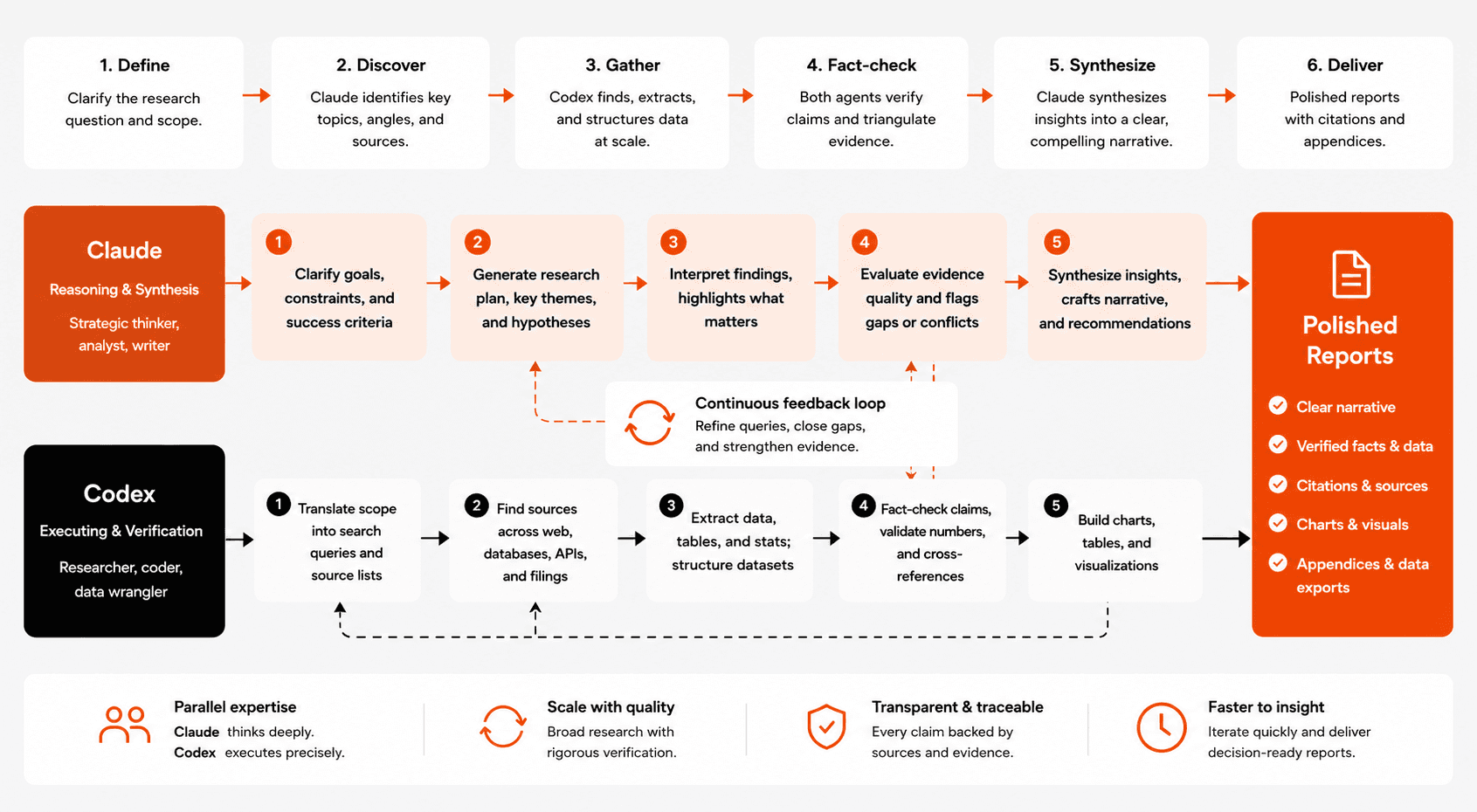
A view of our agentic research workflow that runs in parallel while work on the brief progresses.
You can sit with multiple versions of a flow before committing to three, run twenty takes on a single line of microcopy and watch how each one shifts the tone, and follow an offshoot research inquiry without stalling the rest of the work.
While an agent can produce these forty versions, it is still up to the team to decide the two directions that survive.
What has changed is the cost of looking, discarding work has value by way of sharpening the choices that follow.
This is the part that interests us more than speed itself. Since the familiar tasks get quicker, a whole class of work we always knew was worth doing, but could never quite justify the hours for, becomes practical for the first time.
As the production layer becomes easier to generate and revise, we can spend more time on the decisions surrounding it.
Old-school, human craft becomes a system agents can apply
Whenever AI and design appear in the same sentence, someone asks what happens to the craft. Our answer, so far, is that craft continues to be the most valuable raw material in the building, and AI is most powerful when it augments handmade, old-school craft.
A designer's judgment has always lived in the making.
A thoughtful motion rule gives generated interactions a clear character. A carefully built design system provides better material for a prototype. A prompt library can preserve the reasoning behind a recurring task. A set of JSONs can help maintain a consistent illustration or iconographic style. An evaluation rubric can make the studio’s standards explicit enough to test against.
We have been building all of these in different forms. Every one of these is a human judgment made explicit, and once it's explicit, agents can apply it at scale, but human experience defines the pattern. An agent or a system can evaluate an output against a rubric, but an experienced practitioner decides what the rubric should measure.
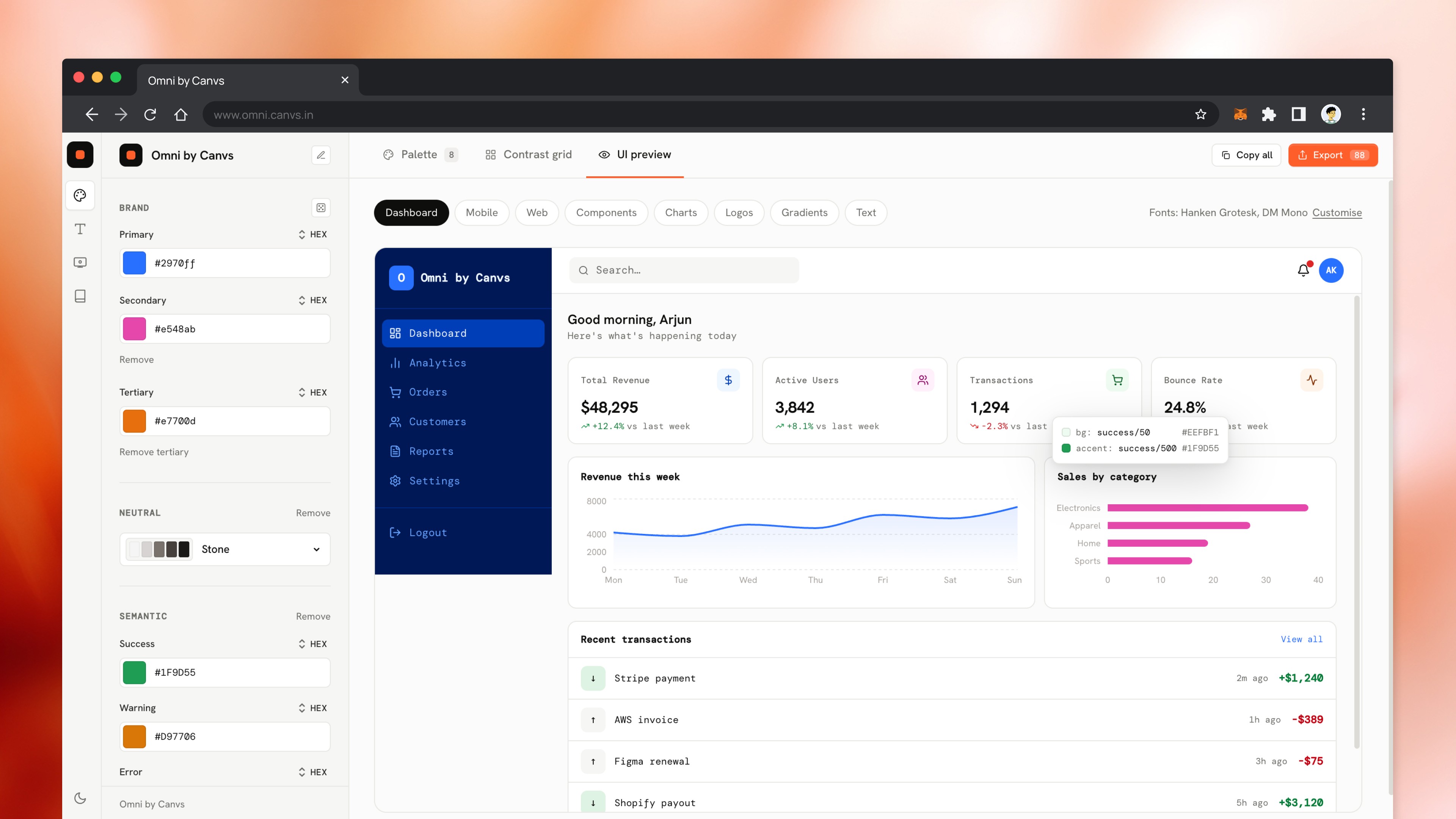
A look at an in-house tool we're building, called Omni, previewing a full color system on a sample dashboard.
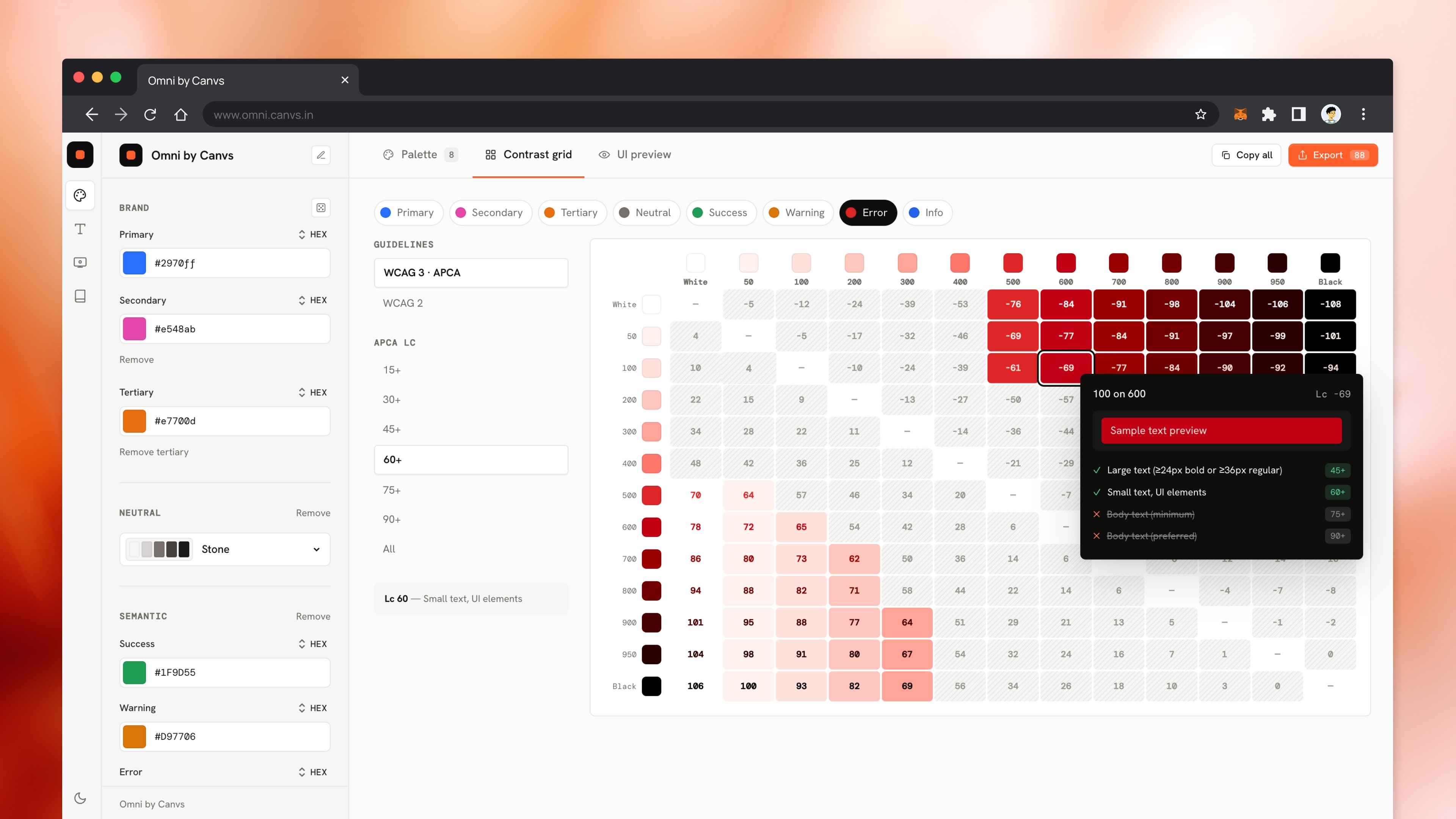
Omni's contrast grid scores every shade pairing on APCA against WCAG 3.
One of our teams recently walked into a client meeting with a working product, where usually, there would be a set of box structures up for review. Instead, we had panels opening on cue, and answers rolling out line by line at the pace of the live product.
It took an evening of prompting and a morning hour of refinement, and most components landed clean on the first try, because the system underneath left the agent little room to guess.
The result was that the people in the room didn’t need to imagine the experience; they could interact with and react to it right there. Point the same setup at a thin design system, and you get thin results; the prototype was good because the decisions underneath it were good, made the old way, by hand, over time.
This working prototype, presented during a pitch for a leading insurance product, shows agentic chat that turns claims guidance into interactive, visual widgets.
A flow from the same proto shows how a prescription turns into an interactive medicine schedule, including checks, timings, and reminders.
Context becomes a persistent, retrievable part of the system
There is an older kind of intelligence in a studio that has nothing to do with screens, and it has always been the most difficult to quantify.
A long project gathers context everywhere: client calls, internal arguments, Figma comments, decisions on the fly because everyone instinctively knew what needed to be done. Considering the large scale of the projects we work on, the deepest context on these products is never in any file, it is us, we are the context. And although we have extensive documentation processes, Design Managers can find themselves conjuring that moment months later from memory, which only works to a point.
We have wanted to capture this context for years. On one long project, working late, we promised ourselves we would log the rationale behind every decision, because someday someone would ask us to justify it. The aspiration was right, but the method didn't exist; nobody can take minutes on two years of their own working life.
Now the method exists.
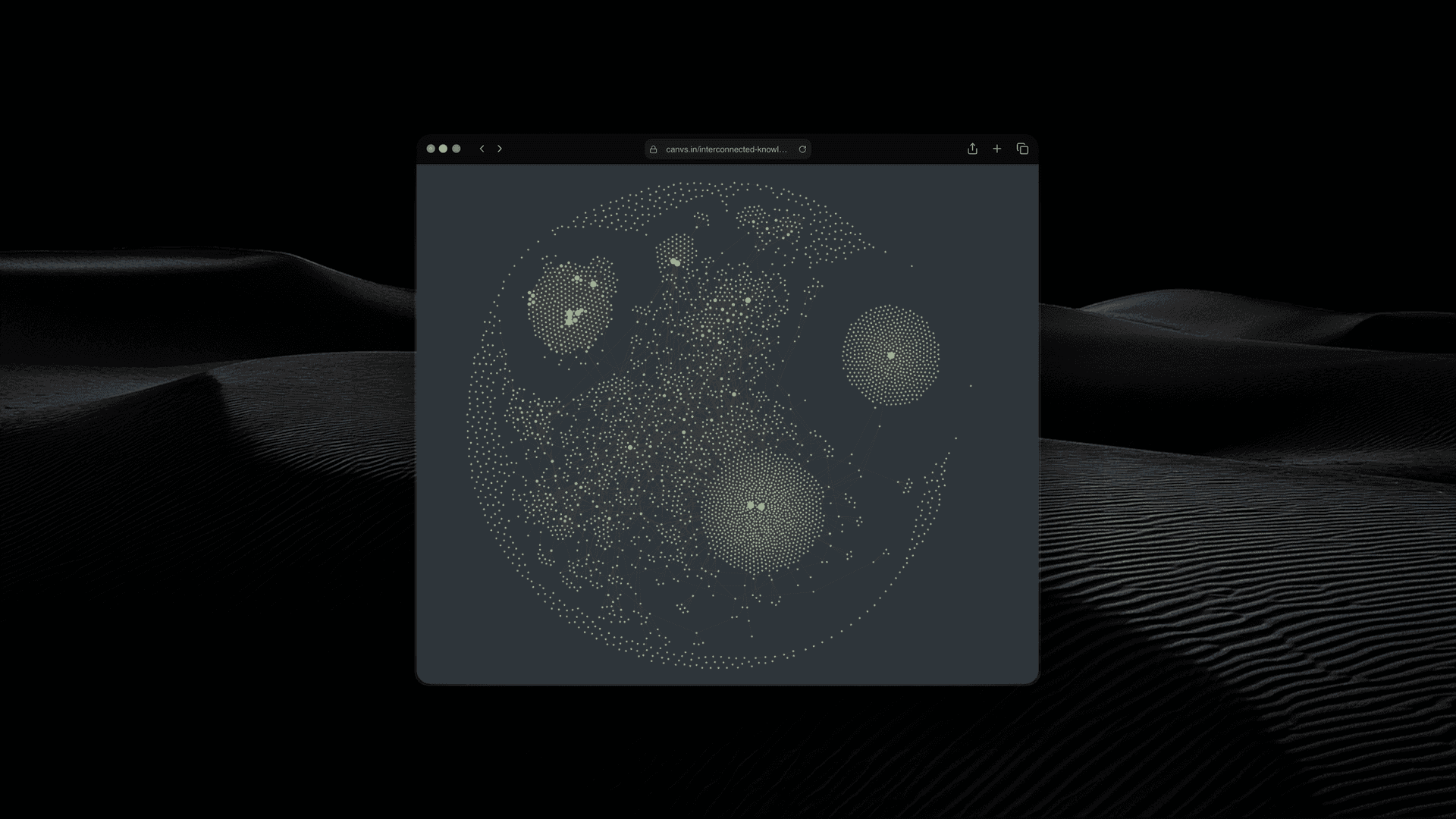
A view of the studio's second brain graph that shows a convergence of all the conversations, ideation, research, design decisions and the day-to-day work of a studio.
One of the systems taking shape inside the studio listens to the ordinary noise of a project, the transcripts, comments, emails and threads, and keeps a running, indexed body of knowledge. Fifteen minutes before a call on a project carrying two years of history, that means a full dossier: timeline, decisions, who said what, the actual quotes, ready in minutes and cleaned into a shareable link in thirty seconds. For instance, a date format settled in passing, stays attached to the project with its rationale, so when the question comes up a year later, the answer returns with it.
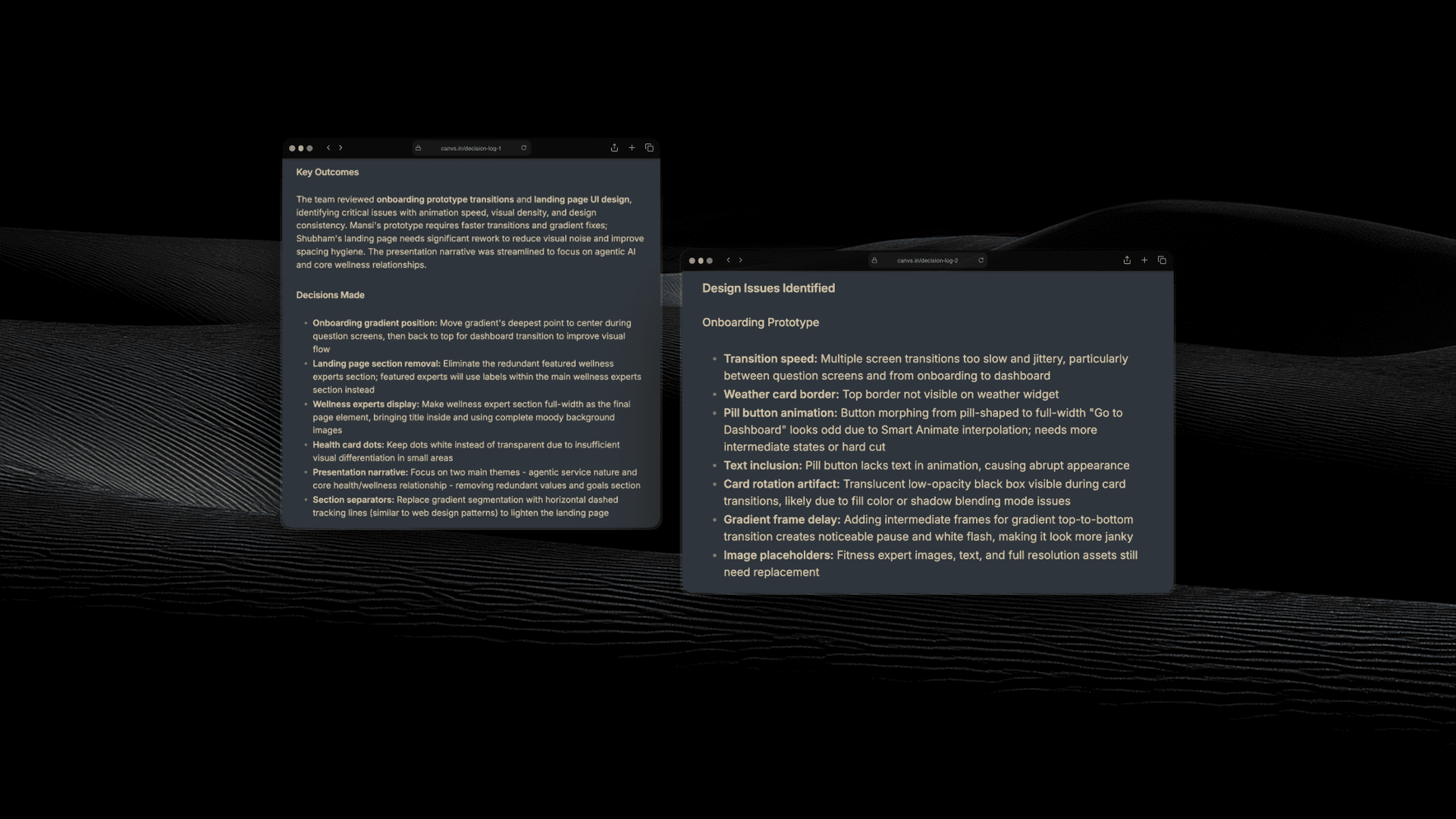
A constantly listening system is able to surface extremely granular insights and outcomes on demand.
Small individual systems and workflows form a studio-wide operating model
None of this has been constructed into a grand platform. Each workflow is incremental; it’s small and a little odd, built by one person for that one specific thing. Together, they are compounding into a system.
Compounding needs a floor, though. As more people across the studio built their own tools, the same requirements kept surfacing under completely different problems: authentication, storage, permissions, compute. None of these is ever the reason a tool exists, yet every new experiment finds itself solving some version of them before it can get to its actual job. So a parallel stream of work is laying shared foundations beneath the experiments, the ‘unsexy’ infrastructure that brings everything to a common standard and lets the next person concentrate on the problem they're actually trying to solve.
That floor is also what lets discovery travel. A workflow built for one person is usually too specific to copy whole, but its spine travels fine. Going from a memory to a full dossier of context in five minutes is a pattern any Design Manager can use, even if the rest of the setup isn't theirs.
A workflow can become a playbook, a playbook can become a shared capability, and the studio stops relearning in October what one person figured out in March.
Through all of it we hold to one threshold: the tools should bend to the person using them. (Anyone who spent two years contorting around prompt engineering will remember which direction the bending used to go.)
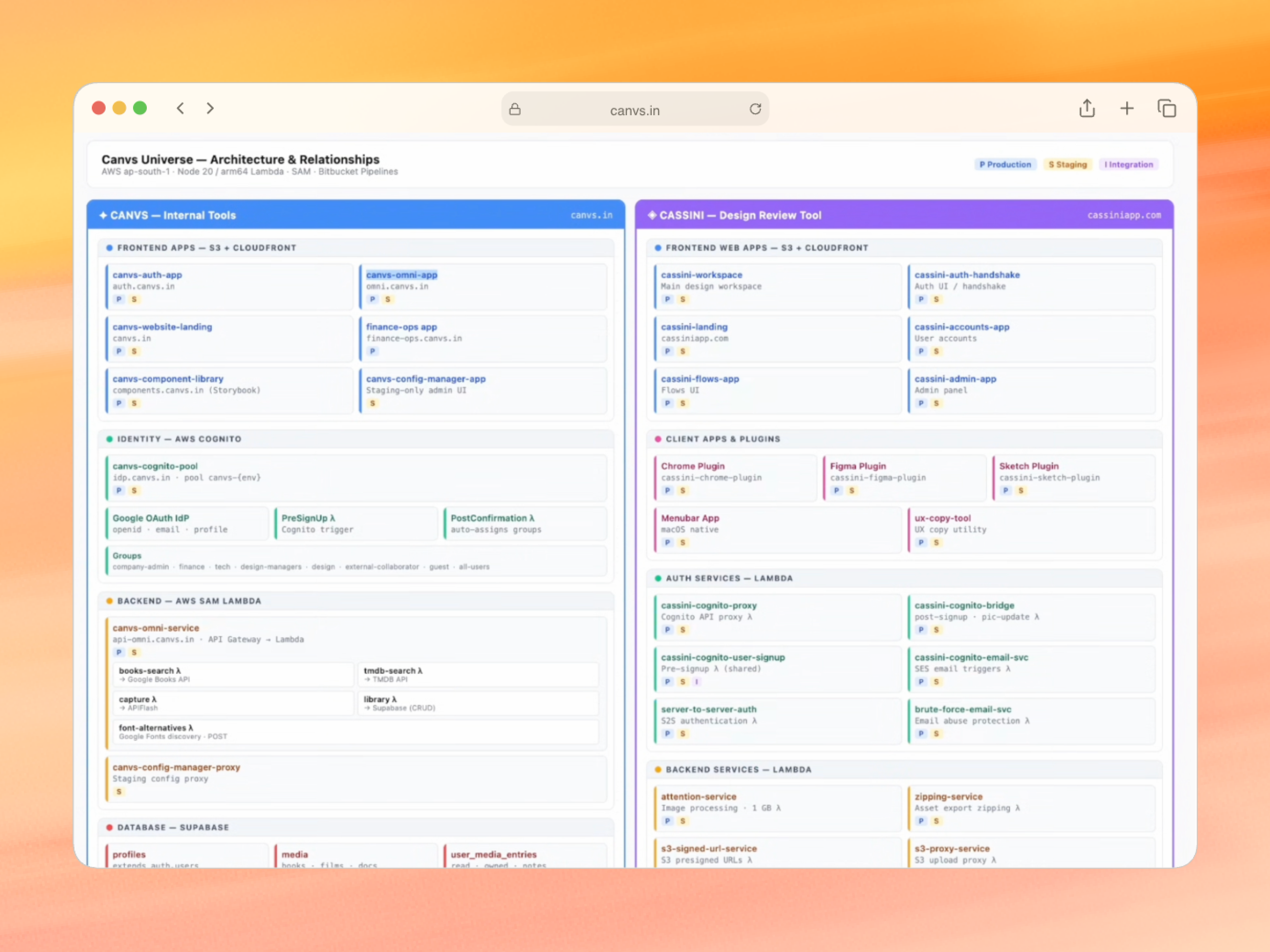
A view of the shared foundation taking shape beneath our internal tools.
As production becomes commoditized, value moves upstream
All of this feeds a larger movement, one we suspect every studio will eventually have to face. When making becomes commoditized, what is made stops being valuable. A screen, a Figma file, an animation, a block of code: these are becoming artefacts, disposable by design, and we say that as a studio that has made a very good living producing them.
Scale used to be the pitch; but scale now comes inherently. What remains scarce when production is abundant is what was always scarce: knowing what to build, and the taste to recognize it when it appears.
The transition that this brings us to, today
Going agentic is still an active transition, and an uneven one: some workflows are daily practice, others are becoming tools, and a few remain one person's strange experiment. What we do know is that the instinct behind it all predates the current models by a decade, and that story, the one about curiosity being genetic to our studio, is for the next piece.
The phrase we keep returning to is faster and better.
Faster gives us more room around the work. Better comes from what we choose to do with that room: investigate more deeply, explore more generously, evaluate more carefully and bring more context intentfully into all our decisions.
The substrate will keep improving for everyone at once. But what's built around it improves the only way it ever has: by us doing the work.