

ACCESSIBILITY

9 MINS

Inclusivity is a question of match-making

Accessibility is usually discussed when something goes wrong. But it rarely fails because of one big mistake. It breaks through small, ordinary decisions that seem reasonable at the time.

Assumptions about who a product is for, what people can do, and how much effort they should be willing to put in. Over time, those assumptions pile up. And before anyone notices, entire groups of people are doing extra work just to get through everyday tasks. This piece looks at where those assumptions come from, and why they keep slipping past even thoughtful teams.

“Exclusion isn’t inherently negative, but it should at least be an intentional choice rather than an accidental harm."

Over the last couple of weeks, we've been publishing a series of pieces on accessibility: looking at how it shows up in everyday products, especially banking and payment apps. In our previous article, we took stock of how accessibility problems have persisted since 2001, and how issues identified decades ago still surface today, even with better tooling and assistive tech.

If that piece focused on what keeps breaking, this one looks at why this happens.

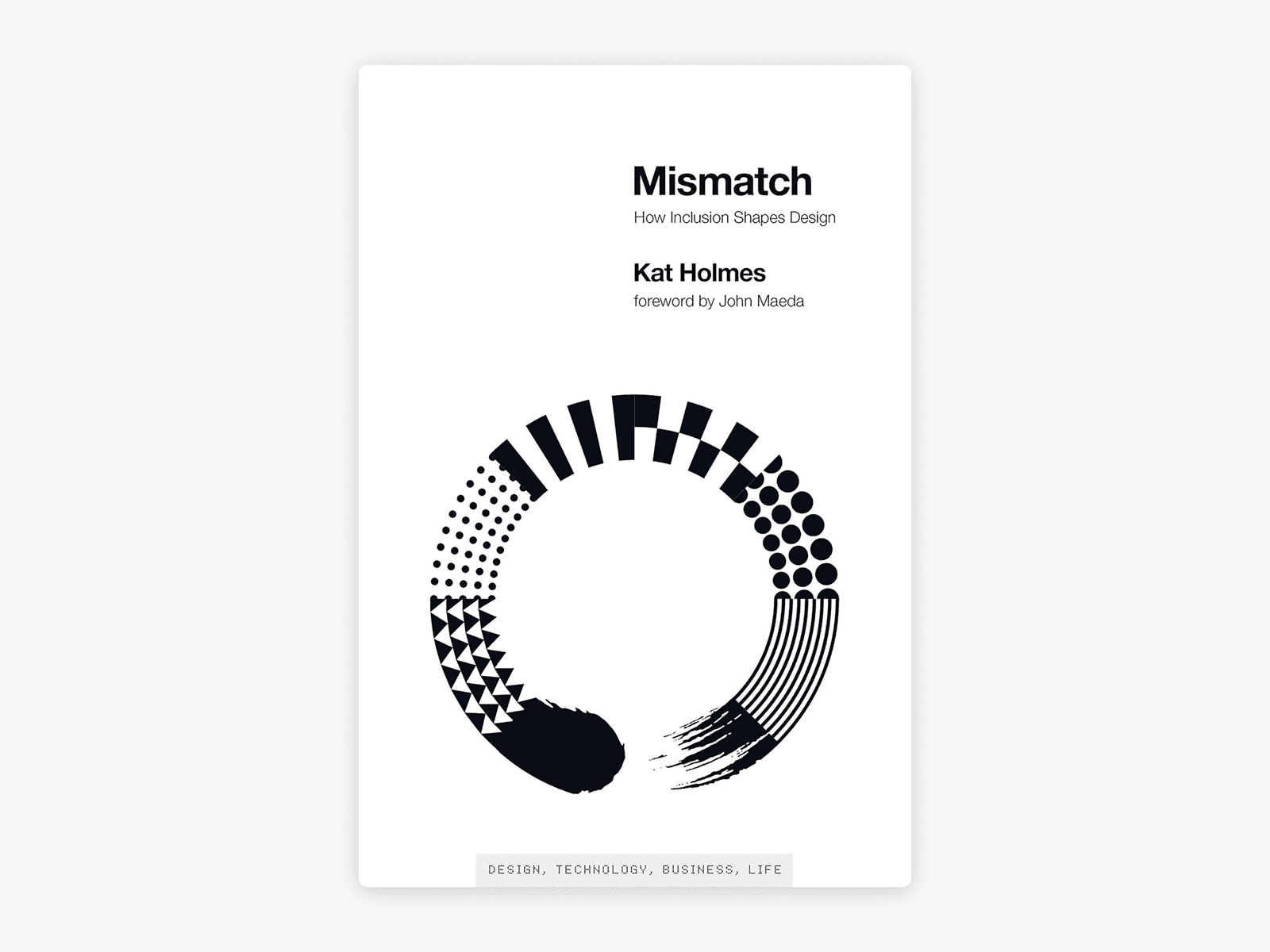
In 2018, Kat Holmes, a designer and accessibility leader who has worked on large-scale products at Microsoft, Google, and later Salesforce, published a book called Mismatch: How Inclusion Shapes Design.
“Exclusion isn’t inherently negative, but it should at least be an intentional choice rather than an accidental harm."

Over the last couple of weeks, we've been publishing a series of pieces on accessibility: looking at how it shows up in everyday products, especially banking and payment apps. In our previous article, we took stock of how accessibility problems have persisted since 2001, and how issues identified decades ago still surface today, even with better tooling and assistive tech.

If that piece focused on what keeps breaking, this one looks at why this happens.

In 2018, Kat Holmes, a designer and accessibility leader who has worked on large-scale products at Microsoft, Google, and later Salesforce, published a book called Mismatch: How Inclusion Shapes Design.

Prompt for a full length capture tool for Cassini

The book grew out of her work building systems used by millions of people, and out of repeatedly seeing the same patterns of exclusion emerge, even in teams that cared deeply about inclusion.

She describes a mismatch as what happens when systems don’t fit the people expected to use them: when people are forced to adapt themselves to make a design work.

The book grew out of her work building systems used by millions of people, and out of repeatedly seeing the same patterns of exclusion emerge, even in teams that cared deeply about inclusion.

She describes a mismatch as what happens when systems don’t fit the people expected to use them: when people are forced to adapt themselves to make a design work.

“People’s touchpoints with each other and with society are full of mismatched interactions. Design is a source of these mismatches, and can also be a remedy.”

“People’s touchpoints with each other and with society are full of mismatched interactions. Design is a source of these mismatches, and can also be a remedy.”

“People’s touchpoints with each other and with society are full of mismatched interactions. Design is a source of these mismatches, and can also be a remedy.”

“People’s touchpoints with each other and with society are full of mismatched interactions. Design is a source of these mismatches, and can also be a remedy.”

What she’s pointing to here is responsibility. If design creates mismatch, it also has the power to reduce it, but only if designers are willing to look at what we’ve normalized.

Instead of trying to integrate people who don’t fit a system, Holmes asks designers to examine the assumptions the system itself is built on. Who is it designed around? What abilities does it assume or expect? And who ends up doing extra work when those expectations don’t hold?

This framing matters for all design, but it becomes especially consequential in digital banking and payment products. These aren’t just tools for convenience; they determine who can move money independently, work around errors, prove identity, and complete everyday transactions without help.

When mismatch shows up here, it impacts freedom and dignity of life, and fetters access to a world that’s open to everyone else.

What follows is a closer look at those assumptions, and what becomes possible once we acknowledge them.

What she’s pointing to here is responsibility. If design creates mismatch, it also has the power to reduce it, but only if designers are willing to look at what we’ve normalized.

Instead of trying to integrate people who don’t fit a system, Holmes asks designers to examine the assumptions the system itself is built on. Who is it designed around? What abilities does it assume or expect? And who ends up doing extra work when those expectations don’t hold?

This framing matters for all design, but it becomes especially consequential in digital banking and payment products. These aren’t just tools for convenience; they determine who can move money independently, work around errors, prove identity, and complete everyday transactions without help.

When mismatch shows up here, it impacts freedom and dignity of life, and fetters access to a world that’s open to everyone else.

What follows is a closer look at those assumptions, and what becomes possible once we acknowledge them.

Assumption 1: Exclusion is accidental, and not designed

Early in the book, Holmes makes a distinction that becomes central to everything that follows. Exclusion, she says, is often framed as a by-product; something unfortunate, but unavoidable. In reality, exclusion is frequently the result of deliberate focus: narrowing who a system is built for, without examining the consequences.

Early in the book, Holmes makes a distinction that becomes central to everything that follows. Exclusion, she says, is often framed as a by-product; something unfortunate, but unavoidable. In reality, exclusion is frequently the result of deliberate focus: narrowing who a system is built for, without examining the consequences.

“Exclusion isn’t inherently negative, but it should at least be an intentional choice rather than an accidental harm.”

“Exclusion isn’t inherently negative, but it should at least be an intentional choice rather than an accidental harm.”

“Exclusion isn’t inherently negative, but it should at least be an intentional choice rather than an accidental harm.”

“Exclusion isn’t inherently negative, but it should at least be an intentional choice rather than an accidental harm.”

She gives examples of objects built for everyday use, such as doors, stairs and chairs that were built very carefully for able bodies.

They are not poorly designed in a general sense; in fact, they are highly optimised. The problem is that they assume strength, reach, balance, or mobility as defaults.

Her point is that the exclusion isn’t accidental in outcome, even if it wasn’t intentional in planning. The design solved one problem very well, but never accounted for the fact that many other people would encounter it.

She gives examples of objects built for everyday use, such as doors, stairs and chairs that were built very carefully for able bodies.

They are not poorly designed in a general sense; in fact, they are highly optimised. The problem is that they assume strength, reach, balance, or mobility as defaults.

Her point is that the exclusion isn’t accidental in outcome, even if it wasn’t intentional in planning. The design solved one problem very well, but never accounted for the fact that many other people would encounter it.

Assumption 2: My abilities are a reasonable default

There is also the idea of ability bias.

There is also the idea of ability bias.

The tendency to solve problems while using our own abilities as a baseline.

The tendency to solve problems while using our own abilities as a baseline.

The tendency to solve problems while using our own abilities as a baseline.

The tendency to solve problems while using our own abilities as a baseline.

This bias can creep in as even the most empathetic of designers test with their own hands, eyes, and attention spans. Reviews happen in rooms where most people share similar physical and cognitive capabilities. Over time, those shared abilities harden into defaults.
This bias can creep in as even the most empathetic of designers test with their own hands, eyes, and attention spans. Reviews happen in rooms where most people share similar physical and cognitive capabilities. Over time, those shared abilities harden into defaults.

Prompt for a full length capture tool for Cassini

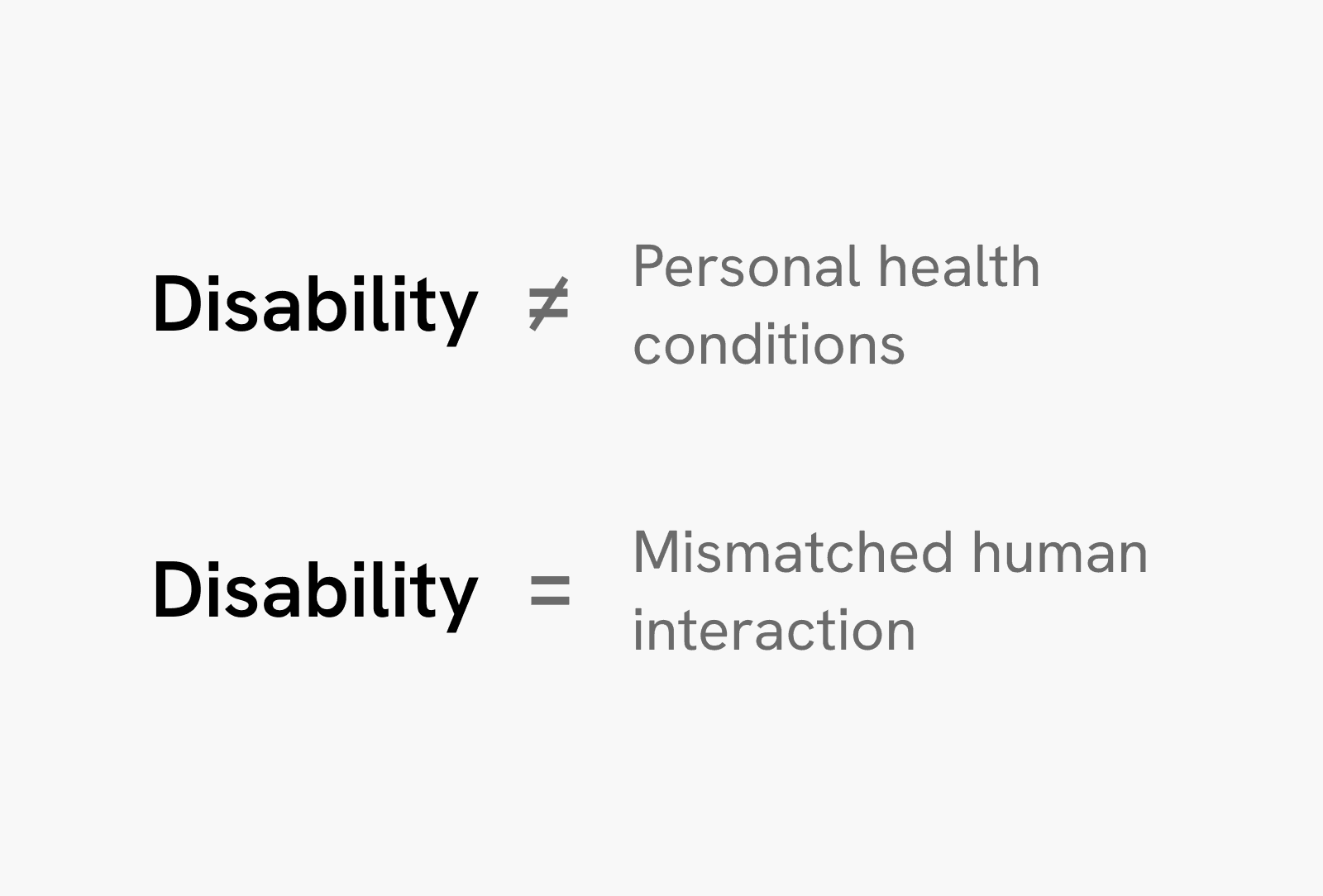
Disability is “a complex phenomenon, reflecting the interaction between features of a person’s body and features of the society in which they live.” - World Report on Disability, 2011, WHO

Disability is “a complex phenomenon, reflecting the interaction between features of a person’s body and features of the society in which they live.” - World Report on Disability, 2011, WHO

Disability is “a complex phenomenon, reflecting the interaction between features of a person’s body and features of the society in which they live.” - World Report on Disability, 2011, WHO

Disability is “a complex phenomenon, reflecting the interaction between features of a person’s body and features of the society in which they live.” - World Report on Disability, 2011, WHO

In Mismatch, the reason that Holmes points to the everyday technologies we mentioned before that privilege vision, speed, or dexterity, is not because anyone decided to exclude on purpose, but because those were the abilities most present during design and decision-making. What feels “intuitive” to the team becomes the standard everyone else is expected to meet.

In Mismatch, the reason that Holmes points to the everyday technologies we mentioned before that privilege vision, speed, or dexterity, is not because anyone decided to exclude on purpose, but because those were the abilities most present during design and decision-making. What feels “intuitive” to the team becomes the standard everyone else is expected to meet.

Assumption 3: Ability is stable

Another idea Holmes returns to repeatedly is one that ability is treated as fixed. Systems are often designed as if people’s capacities don’t change, as if someone who can navigate a product once will always be able to do so.

In reality, ability fluctuates across time and context: injury, illness, fatigue, stress, environment, and age. A person who can use a system with ease one day may struggle the next, because while they’ve not essentially changed, their conditions have.

Another idea Holmes returns to repeatedly is one that ability is treated as fixed. Systems are often designed as if people’s capacities don’t change, as if someone who can navigate a product once will always be able to do so.

In reality, ability fluctuates across time and context: injury, illness, fatigue, stress, environment, and age. A person who can use a system with ease one day may struggle the next, because while they’ve not essentially changed, their conditions have.

When a designed object rejects a person, it can feel like social rejection and approximate physical pain.

When a designed object rejects a person, it can feel like social rejection and approximate physical pain.

When a designed object rejects a person, it can feel like social rejection and approximate physical pain.

When a designed object rejects a person, it can feel like social rejection and approximate physical pain.

The implication here is important. When products assume stable ability, they inevitably fail people at moments when they are least able to compensate, and that has a lasting effect.

The implication here is important. When products assume stable ability, they inevitably fail people at moments when they are least able to compensate, and that has a lasting effect.

Assumption 4: People should adapt when systems
don’t fit
Assumption 4: People should adapt when systems
don’t fit

One of the most human observations in Mismatch is how much effort people put into making systems work, even when those systems don’t fit them.

One of the most human observations in Mismatch is how much effort people put into making systems work, even when those systems don’t fit them.

“People often have to adapt themselves to make an object work.”

“People often have to adapt themselves to make an object work.”

“People often have to adapt themselves to make an object work.”

“People often have to adapt themselves to make an object work.”

Holmes describes how users memorise steps, rely on workarounds, ask for help, or avoid certain interactions entirely. This adaptation is often invisible to the organisations building the product because for all purposes, the system appears to function and usage continues.

But adaptation is not inclusion. Here, effort is shifted onto the user. And over time, that effort becomes exhausting.

Holmes points out that exclusion often only becomes visible when adaptation fails; when no amount of ingenuity can bridge the gap between a person and a system that simply doesn’t accommodate them.

Holmes describes how users memorise steps, rely on workarounds, ask for help, or avoid certain interactions entirely. This adaptation is often invisible to the organisations building the product because for all purposes, the system appears to function and usage continues.

But adaptation is not inclusion. Here, effort is shifted onto the user. And over time, that effort becomes exhausting.

Holmes points out that exclusion often only becomes visible when adaptation fails; when no amount of ingenuity can bridge the gap between a person and a system that simply doesn’t accommodate them.

Assumption 5: When something goes wrong, it’s the user’s fault

Closely related to the assumption we talked about before this, is the tendency to frame failure as user error. If someone struggles while using a certain product or feature, the assumption can often be that they misunderstood, didn’t pay attention, or lacked skill.

Instead, it is better to look at this as:

Closely related to the assumption we talked about before this, is the tendency to frame failure as user error. If someone struggles while using a certain product or feature, the assumption can often be that they misunderstood, didn’t pay attention, or lacked skill.

Instead, it is better to look at this as:

“Mismatches between people and objects, physical or digital, happen when the object doesn’t fit a person’s needs.”

“Mismatches between people and objects, physical or digital, happen when the object doesn’t fit a person’s needs.”

“Mismatches between people and objects, physical or digital, happen when the object doesn’t fit a person’s needs.”

“Mismatches between people and objects, physical or digital, happen when the object doesn’t fit a person’s needs.”

Moments when users are confused, come across errors, or when they abandon a product or feature, should be treated as signals of poor fit, rather than poor user understanding.The responsibility lies with the system, with how it was designed and shaped, to be fully usable, instead of the person encountering it.

This intentional shift in the way of thinking helps designers stop asking “why didn’t they get it?” and start asking “what did we assume that didn’t hold true?”

Moments when users are confused, come across errors, or when they abandon a product or feature, should be treated as signals of poor fit, rather than poor user understanding.The responsibility lies with the system, with how it was designed and shaped, to be fully usable, instead of the person encountering it.

This intentional shift in the way of thinking helps designers stop asking “why didn’t they get it?” and start asking “what did we assume that didn’t hold true?”

Assumption 6: Disability is rare and is a peripheral or fringe problem

We should also challenge how disability is framed within design and organisations.

We should also challenge how disability is framed within design and organisations.

“Disability is often treated as a permanent condition affecting a small group of people.”

“Disability is often treated as a permanent condition affecting a small group of people.”

“Disability is often treated as a permanent condition affecting a small group of people.”

“Disability is often treated as a permanent condition affecting a small group of people.”

This framing allows exclusion to be deprioritised. If disability is seen as niche, accessibility becomes optional; something to consider later, if at all.

But as we’ve established disability can often be produced by design decisions themselves. When systems fail to account for human diversity, they create disability in context. In this sense, disability isn’t rare or something that a small group of us live with, it’s an outcome of mismatch.

This framing allows exclusion to be deprioritised. If disability is seen as niche, accessibility becomes optional; something to consider later, if at all.

But as we’ve established disability can often be produced by design decisions themselves. When systems fail to account for human diversity, they create disability in context. In this sense, disability isn’t rare or something that a small group of us live with, it’s an outcome of mismatch.

Assumption 7: Small frictions don’t matter

As we look at systems at scale, Holmes emphasises how minor decisions can have outsized effects.

As we look at systems at scale, Holmes emphasises how minor decisions can have outsized effects.

“At that scale, one small exclusionary misstep can have an amplifying negative effect.”

“At that scale, one small exclusionary misstep can have an amplifying negative effect.”

“At that scale, one small exclusionary misstep can have an amplifying negative effect.”

“At that scale, one small exclusionary misstep can have an amplifying negative effect.”

Scale magnifies harm, and it is important we understand this. When design choices are repeated across products, platforms, and entire ecosystems, they compound into structural exclusion, locking out millions of us. What might seem negligible in isolation becomes significant when encountered repeatedly by so many users.

Scale magnifies harm, and it is important we understand this. When design choices are repeated across products, platforms, and entire ecosystems, they compound into structural exclusion, locking out millions of us. What might seem negligible in isolation becomes significant when encountered repeatedly by so many users.

Assumption 8: There is a normal user

Later in the book, Holmes dismantles the idea of designing for an average or “normal” user.

Later in the book, Holmes dismantles the idea of designing for an average or “normal” user.

“If there is no normal user, there is also no extreme user.”

“If there is no normal user, there is also no extreme user.”

“If there is no normal user, there is also no extreme user.”

“If there is no normal user, there is also no extreme user.”

She critiques personas and averages that collapse human variation into a single fictional centre. When design optimises for that centre, everyone else is pushed to the margins by default.

This is how accessibility comes to be framed as an exception, rather than as a core measure of whether a system fits the people it serves.

She critiques personas and averages that collapse human variation into a single fictional centre. When design optimises for that centre, everyone else is pushed to the margins by default.

This is how accessibility comes to be framed as an exception, rather than as a core measure of whether a system fits the people it serves.

Assumption 9: Inclusion can be added later

Inclusion cannot be retrofitted without consequence.

Inclusion cannot be retrofitted without consequence.

“When inclusion is treated as an afterthought, exclusion becomes embedded.”

“When inclusion is treated as an afterthought, exclusion becomes embedded.”

“When inclusion is treated as an afterthought, exclusion becomes embedded.”

“When inclusion is treated as an afterthought, exclusion becomes embedded.”

Early framing decisions like what problems are worth solving, which users are prioritised, what success looks like, go on to shape everything that follows. When inclusion is deferred, the system grows around its exclusions.

Late fixes may reduce harm, but they rarely undo it completely.

Early framing decisions like what problems are worth solving, which users are prioritised, what success looks like, go on to shape everything that follows. When inclusion is deferred, the system grows around its exclusions.

Late fixes may reduce harm, but they rarely undo it completely.

Assumption 10: Exclusion is hard to see

In closing, Holmes challenges the idea that exclusion is abstract or subjective.

In closing, Holmes challenges the idea that exclusion is abstract or subjective.

“Exclusion is recognisable. It’s measurable and tangible.”

“Exclusion is recognisable. It’s measurable and tangible.”

“Exclusion is recognisable. It’s measurable and tangible.”

“Exclusion is recognisable. It’s measurable and tangible.”

She urges designers and organisations to look closely: at who struggles, who relies on help, who drops off, and who never arrives as not being anomalies. These groups of users should rather be treated as evidence to develop better solutions.

She urges designers and organisations to look closely: at who struggles, who relies on help, who drops off, and who never arrives as not being anomalies. These groups of users should rather be treated as evidence to develop better solutions.

So, how do we change to be more inclusive?

We start by accepting that building inclusion is a skill, rather a stance. It’s something we learn over time, through attention and practice, instead of something we arrive at by saying the right things once.

Most of us were never taught how to recognise exclusion as we design. So the first shift comes from learning to notice where our systems ask people to adapt themselves in order to participate. When something feels hard to use, confusing, or exhausting for someone else, that friction is information. It’s telling us something about the assumptions we’ve built in.

Change also asks us to get comfortable with imperfection. We won’t design something that works equally well for everyone, and that’s okay. What matters is staying open to learning when a solution doesn’t fit, and being willing to adjust rather than defend it.

And finally, we treat inclusion as ongoing work. Every new feature, every update, every handoff introduces fresh chances for mismatch. When we make space to revisit decisions, ask better questions, and listen more closely, inclusion stops being an aspiration and starts becoming part of how we work.

We can’t change everything at once, but we can pay attention and choose to respond with honesty.

We start by accepting that building inclusion is a skill, rather a stance. It’s something we learn over time, through attention and practice, instead of something we arrive at by saying the right things once.

Most of us were never taught how to recognise exclusion as we design. So the first shift comes from learning to notice where our systems ask people to adapt themselves in order to participate. When something feels hard to use, confusing, or exhausting for someone else, that friction is information. It’s telling us something about the assumptions we’ve built in.

Change also asks us to get comfortable with imperfection. We won’t design something that works equally well for everyone, and that’s okay. What matters is staying open to learning when a solution doesn’t fit, and being willing to adjust rather than defend it.

And finally, we treat inclusion as ongoing work. Every new feature, every update, every handoff introduces fresh chances for mismatch. When we make space to revisit decisions, ask better questions, and listen more closely, inclusion stops being an aspiration and starts becoming part of how we work.

We can’t change everything at once, but we can pay attention and choose to respond with honesty.

Subscribe to Design & Tech Weekly

An often riveting list of design and tech resources!

©2025 Canvs

Subscribe to Design & Tech Weekly

An often riveting list of design and tech resources!

©2025 Canvs

Subscribe to Design & Tech Weekly

An often riveting list of design and tech resources!

©2025 Canvs

Subscribe to Design & Tech Weekly

An often riveting list of design and tech resources!

©2025 Canvs