
Harleen:
You and I have both been doing design management for a while now, and we’ve seen how clients work with different kinds of agencies. If we had to explain to someone outside what we actually do as design managers at Canvs… what do you say first? Like, what’s the cleanest way to describe the job without making it sound like ‘project management but cooler’?
Abin:
Alright, so our job as Design Managers is to take a business problem and stay responsible for how it turns into a real, usable product. The obvious impression would be that we’re managing timelines and people. But in reality, we’re accountable for the quality of the design process, the granular and high-level decisions made in service of the work, and how the project finally ships. While we are constantly in touch with the client teams to understand business goals and requirements, we also take it upon ourselves to balance that with customer needs and come up with a product that satisfies both parties. We're involved from the start, all the way till development and audits.
"At Canvs, a DM is a designer first. So when a client comes with a requirement, we help them define the UX problem, highlight any gaps if any, shape the solution, guide the team and make sure what goes out actually works."
Harleen:
So, what's the thing people assume we'd do like other places that's not true?
Abin:
People often assume we're like traditional project managers or creative managers who mainly coordinate reviews and track deadlines.
But the thing about the DM role here is that we’re very much inside the work. We’re doing internal audits, figuring out why something works or doesn’t, helping designers push it further, handling client reviews, talking through layout choices, defending design decisions and so on.
Project managers aren't typically this close to the craft side of things as we are. They focus more heavily on the planning and delivery logistics. That's a major differentiator.
Harleen:
Something we talk about often is having a single point of contact. I’ve seen through my time representing Canvs that most teams almost always end up depending deeply on the assigned DM for all matters of their project, design or not. They know they can come to us. Has this happened to you?
Abin:
That's a good one. With the corporate clients we work with, things are usually complex at their end. They have multiple product teams, platform teams, internal stakeholders, and sometimes even external vendors. When they work with an agency, they don't want to manage another layer of complexity.
One thing we’ve both seen at Canvs is how design managers reduce the number of touchpoints a client has to deal with. Clients know exactly whom to go to for a question, a change or even an escalation. They don't need to figure out which designer is working on what. The DMs carry the full responsibility and context of the project and speak for the entire project.
What we also do internally is to share any outlier or pattern changes with all DMs involved, so we are in sync.
Harleen:
But at the end of the day, as a client, I'm looking at numbers. I think it helps the economics of projects that their individual design partners also deal with the project management overheads.
Abin:
Frankly, our style of design management saves cost and time in very real ways and not just because it's the same person dealing with two different aspects of the project. It's about being the right person for the job. Since as DMs working on your brief, we understand both design complexity and effort, we're able to set more realistic timelines early on. The briefing calls are also more productive because we're able to discuss and close ambiguities right at the start. From a business point of view, it's simply more efficient.
This translates to fewer surprises later during development, fewer redesigns, and less time wasted fixing things.
Harleen:
Right, and because we have knowledge across multiple projects, we end up carrying context that the client themselves may not be aware of, because we’re speaking to multiple teams. Have you seen this sort of cross-pollination show up in your work? What’s a good example?
Abin:
A good example is when we see patterns repeat across modules we handle for the same client. Maybe one product team struggled with a particular way of surfacing information, and we learned what worked and what didn’t.
We realised what they wanted was to have a cleaner experience, only surface key metrics upfront and have a second layer surface extensive details. Once this approach is designed and finalised, we are able to pitch this to other product teams within the same ecosystem as well.
It also works the other way. Sometimes we know what NOT to do because of regulatory issues or past feedback. That knowledge travels with us across modules, even if the client isn't aware of it. Over time, this shared context helps us make better decisions faster.
So when clients face a problem, we don't have to necessarily start from scratch. We already have context, references and learnings that can be borrowed and implemented.
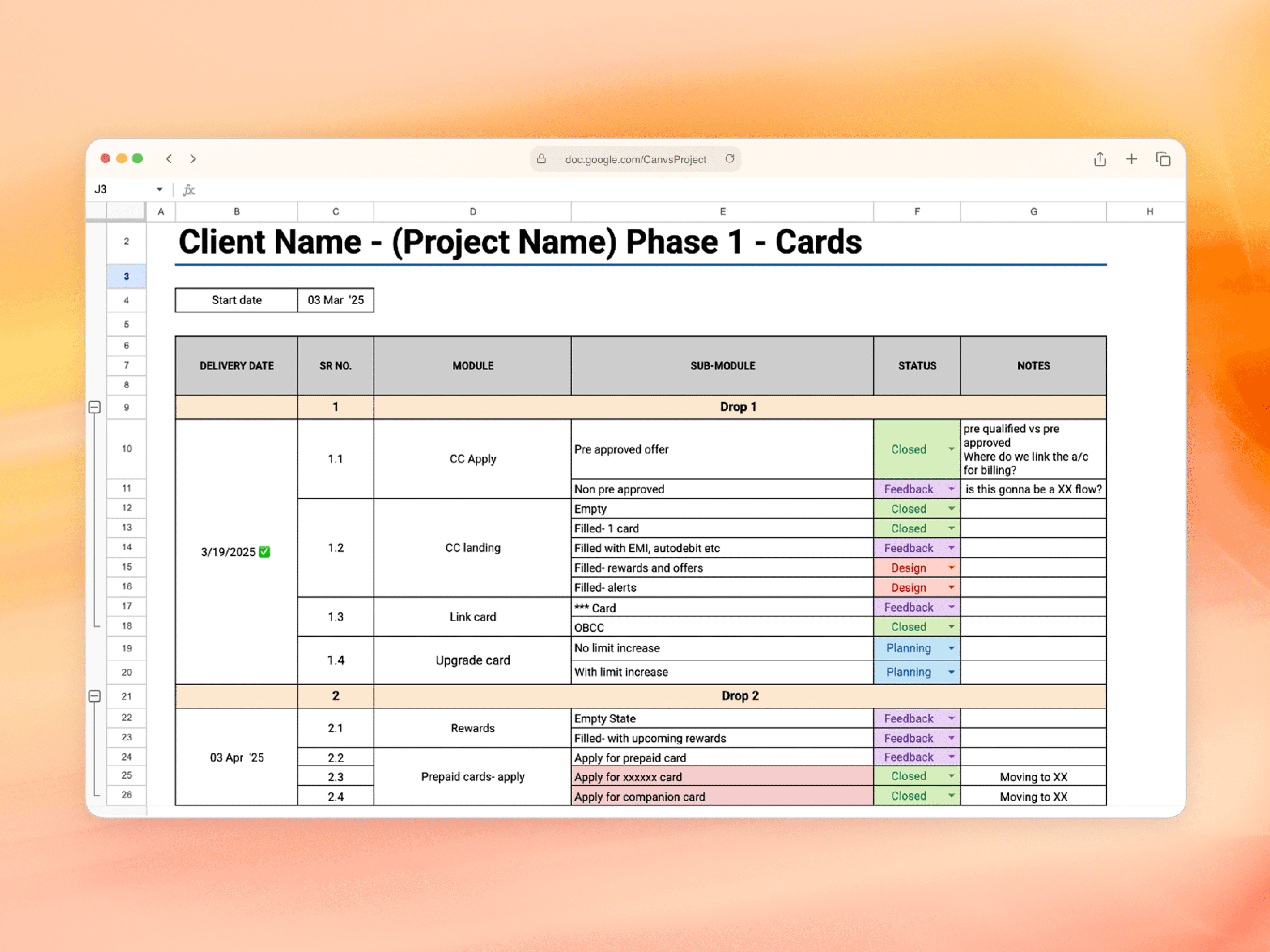
Client-facing trackers help DMs stage where different deliverables are in the pipeline, what inputs have been received, which ones are pending, and where perhaps information overlaps can help individual client teams maintain coherence over an enterprise or legacy product with multiple sub-units.
Abin:
Ok, I want to pick up something that I think is the differentiator. Most setups have a PM / creative manager who's not hands-on in design. What actually changes when the DM is a practicing designer, like we have at Canvs? While I have my thoughts on this, I want to understand from you, as a trained designer, what's your opinion on this?
Harleen:
I think the main advantage of having a DM speak to you is the ownership and know-how we can bring.
We're not just messengers relying on other internal teams for the right information. For example, if a client were to request certain changes or require certain clarifications during a call or a meeting, a DM can actually provide the right answers there immediately, and maybe even estimate the exact amount of time required to come back with an updated set of screens.
A DM is also equipped to discuss why something would not work or why a certain approach was chosen over any other. And that's not only coming from the background of design knowledge, but from being an integral part of the process at every step and really understanding it.
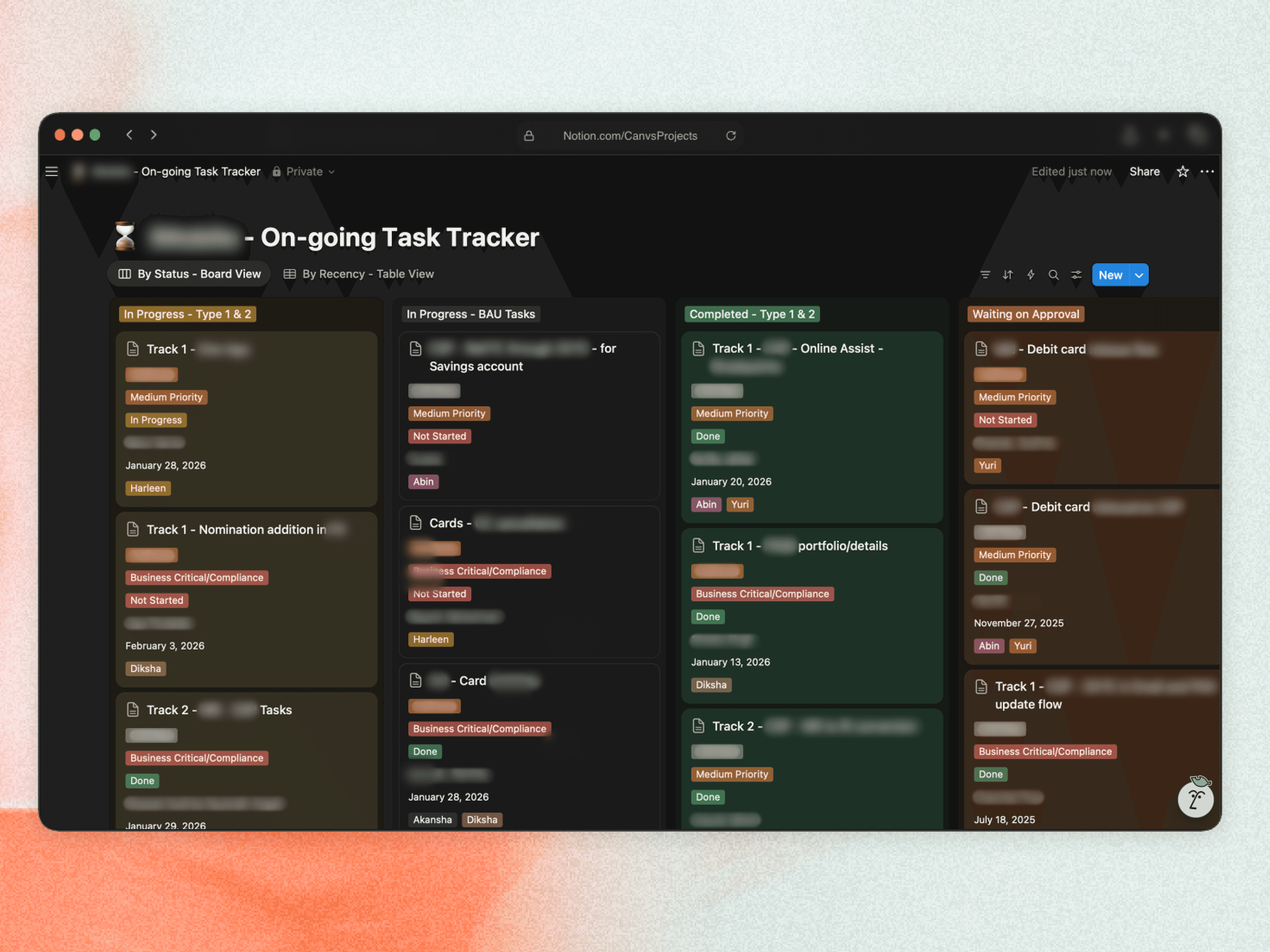
There's an ongoing task tracker for parallel projects and asks with client POCs mentioned, so that DMs can maintain oversight over resource allocation and time-lining.
Abin:
We're also really particular about prep; we hate walking into meetings cold. Can you talk about what this sort of prep actually means for us?
Harleen:
I’m not sure who likes walking into a meeting being clueless! But on a more serious note, this is entirely true. Most of the time, even for a new brief within the same project, we ask clients to share a BRS or some documentation beforehand, while scheduling the meeting.
This way, when we show up, we’ve already understood the material and have gone through the ask, and we’re ready to dive right into doubts or clarifications, or anything else the client may want to highlight. It isn’t just time efficient, it also ensures our clients know that we’re building this WITH them. That we’re not just here to execute, but to actually take ownership.
The same habit, when scaled up for larger projects, looks a little different. We document everything every step of the way. So when it comes to presenting a larger module, for example, we walk into those rooms with all our material - all the research, design decisions, competitive benchmarking, everything documented and arranged.
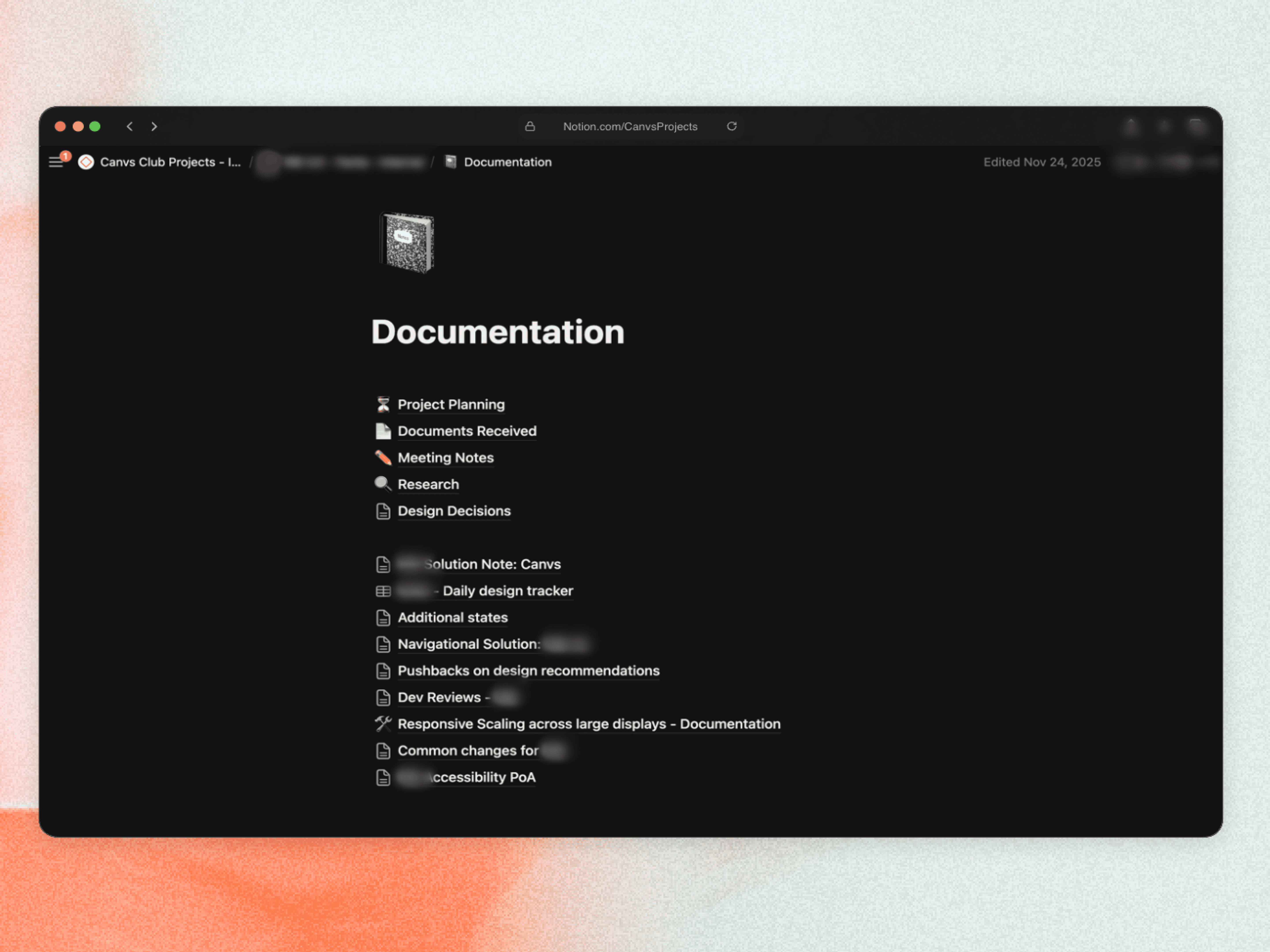
Every stage of each project is meticulously documented so that it becomes a repository of information.
This way, when I’m building the context while telling you why and how we got to the final product I’ve brought to the table, I have all the background at the ready - you need only ask.
And of course, this process can be daunting. I remember being rather nervous at first. I mean, we’re walking into conference rooms with some of the top decision makers sitting there, you know? They’re working with us to build products that millions of users are going to be interacting with! It’s a lot.
But you’ll find that there is no better antidote to that nervous feeling, to that anxiety, than preparedness. The more I know, the less stressed I am about a meeting. And sure, leadership skills and all the training of soft skills, these are extremely helpful to stay level, no doubt. But prep, knowledge and documentation - that’s irreplaceable. That’s what allows me to present our work, in any daunting room, with such confidence.
Abin:
So, when a client asks the classic ‘why did you do this?’, how does this help you take ownership? What does it look like when you take full ownership of design intent on a call? What are you actually doing differently in that moment?
Harleen:
It’s back to the same DM vs PM comparison, right? Since DMs are so deeply involved in every part of the process, when a client is asking us ‘Why?’, we’re not just telling them something generic like “Oh, we explored other options, and this is the one that works best.”
We get into specifics, into details that have informed each design decision, into why something has been chosen over an obvious alternative. And if even then, something does not work for the client, we treat it like a problem we’re solving together.
There’s never any separation between them and us - we’re all here trying to build the best product together - and we’re here to use our individual strengths to bolster that process, not to cut each other down or compete with each other. I think this makes all the difference.
There’s so much trust and belief that is required for this process to work, and today, (I’m grateful and lucky to say), we have that. We’ve earned that by truly working with our clients, and not just for them.
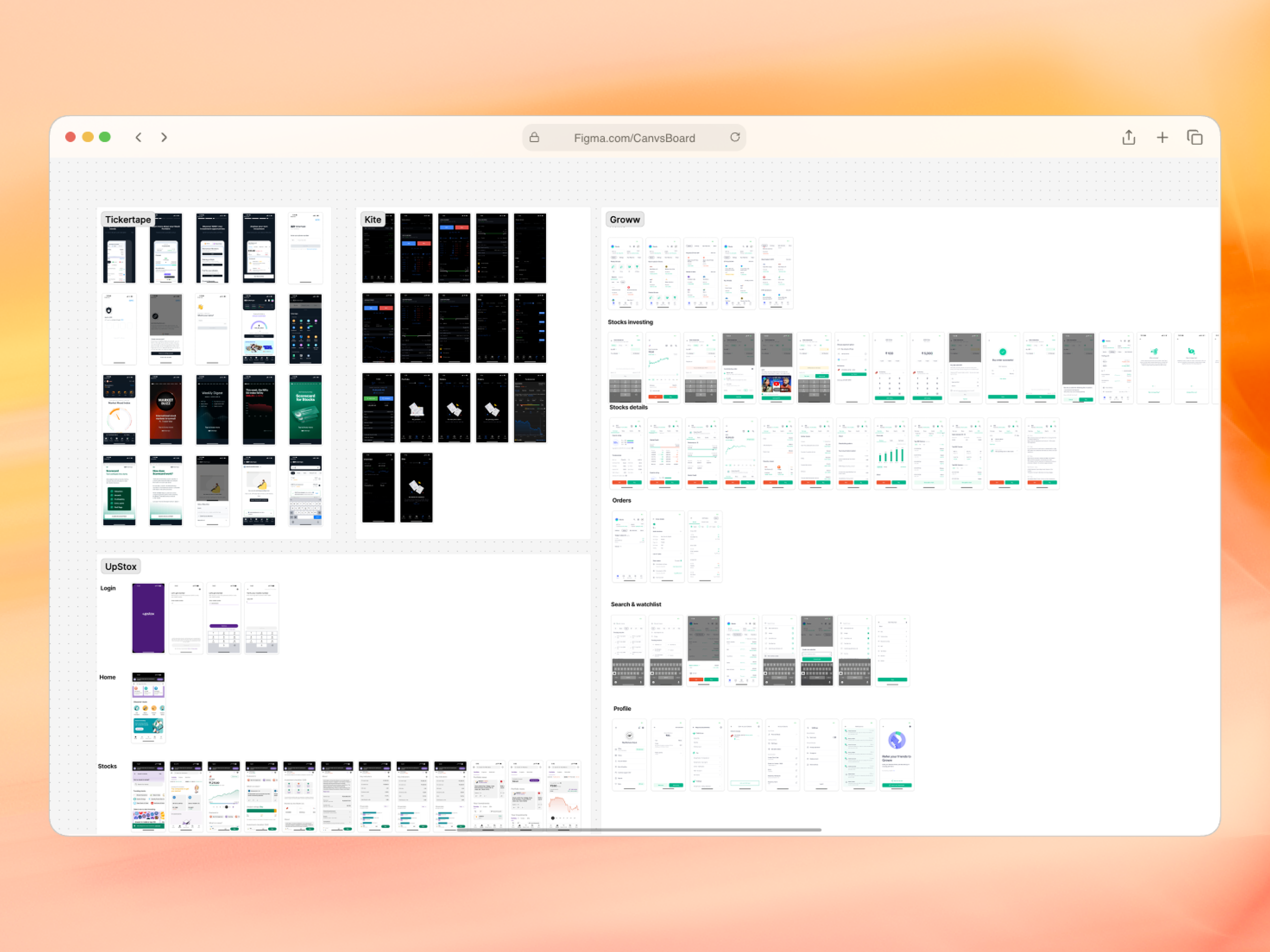
Usually, while working on a new ask or designing a new flow, extensive visual research is carried out, which includes a deep audit of category-leading products.
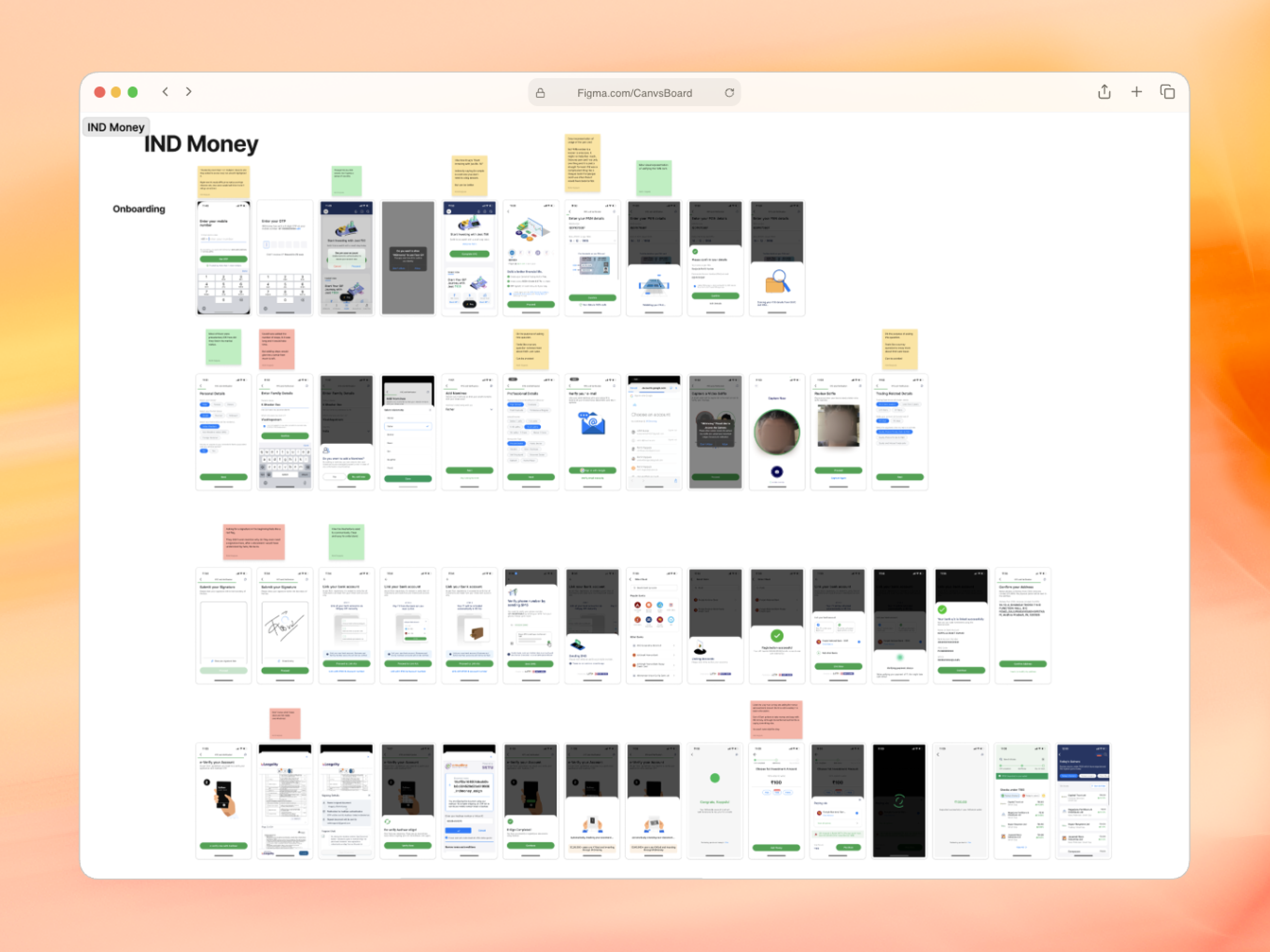
The audit is then meticulously annotated, with short callouts on why certain features standout or why a certain flow was included.
Abin:
When we were prepping for this chat, you also said something I really liked: we’re almost never caught in a moment of ‘I can’t help you’. We might say ‘give me a day’, but not ‘I don’t know what to do.’
Harleen:
This is a great way to summarise what I was saying earlier - the prep, the rigour of research and documentation, the trust and collaboration, all of that results in each of us being able to say this. It comes back to ownership and to actually taking charge.
Now that being said, we do have multiple DMs on every project, and each of us brings our own flavour to the role. This is something that our clients have realised too. Very often, one of them will reach out to one of us specifically, and it’s quite clear that they’ve realised who to come to for which exact flavour.
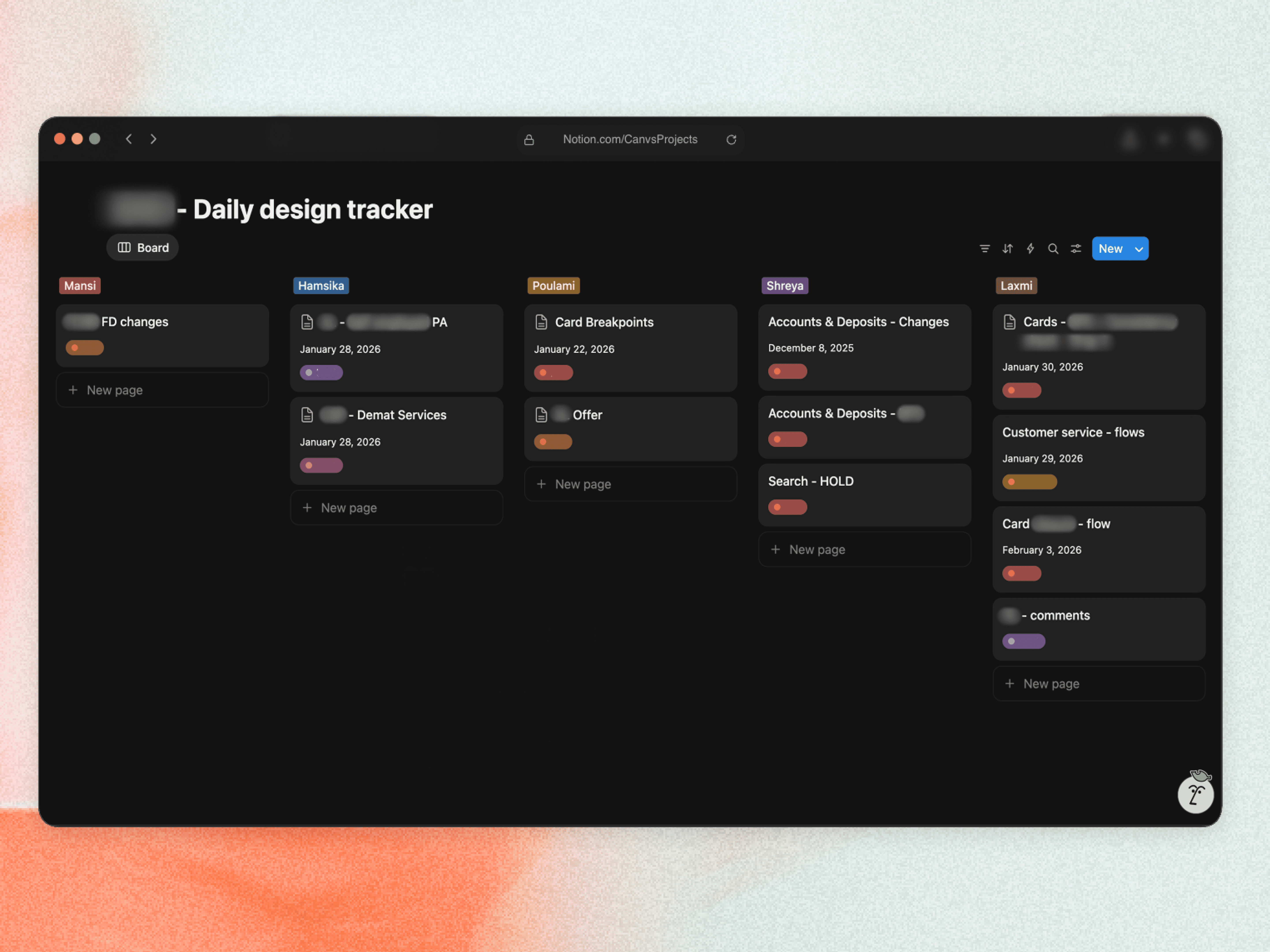
DMs also have a more granular day-to-day internal tracker for daily deliverables with teams.
For instance, all folks on the client end are acutely aware of how much I follow process, and hence how likely I am to say no to ad-hoc tasks. They’re very less likely to give me a call with some ad-hoc request. But they’re also aware of how quickly I can turn something around, and how I’d probably be the right person to call with a request that needs to be taken up despite the tracker. So I end up receiving more of the open-ended problem statements - ‘we’re not sure what to change, but this is the problem. Can you look into it? Give us some options.’
The same example, when taken for you, Abin, you’ve been identified as the most diligent of us all, and rightly so. The requests that you receive are so, so very specific to your brand of design management. All our clients know how detailed your work is, and they know exactly when to bring you in - when a certain (extra) level of depth is required, more than our usual amount of attention to detail.
And again, all of these asks come from trust, relationships that are built over an extended period of time of working with each of us, and understanding each other. Our clients know we’ll all get them there for sure. It’s the ‘how’ that is different.
Harleen:
Which brings me to this internal layer we have to sometimes explain to clients: we don’t just take a requirement and end up with ‘bana diya’. We sit with designers, we question flows, we sometimes bring examples from other products, all before it ever reaches the client. Can you talk about this coherence role we play?
Abin:
That’s an important one. One would expect the client-agency relationship to be a one-way street where the agency just needs to execute what the clients ask of us.
At Canvs, there are times when we push back on certain flows or patterns if we feel it’s not in the best interest of the customers and the product. And you’d be surprised how often clients appreciate such push-backs when they’re supported by reason and logic, and when we can convince them of these.
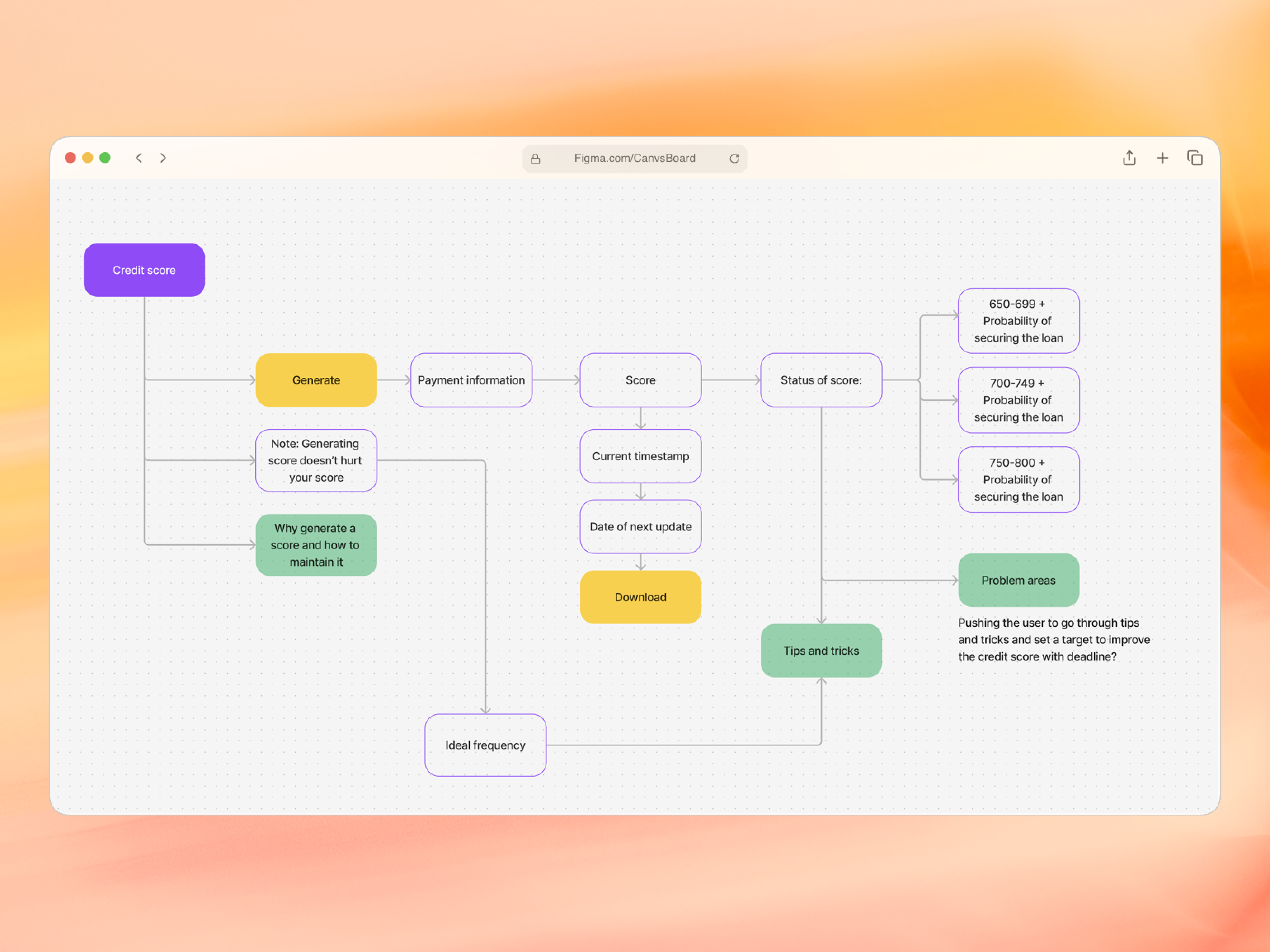
The visual research and audit stage turns into a mind-mapping exercise of what flows look like in the present-day, where are the gaps, what can be improved and what can be innovated and customized specifically to the ask or project at hand.
What this also does is it creates a sense of confidence in our clients to try and test new ideas because they’re aware of an additional layer of thinking and reasoning at our end, which will go into the process before getting to execution.
Now, once the idea or suggestion is taken up, that is where us being designers first really matters. Before anything is sent for client review, we have multiple internal conversations.
We sit with the team, review flows, question assumptions, check consistency with the design system, and sometimes, bring in examples from other products or industries.
At the end of the day, we ensure that the output reaching the clients is the most polished they can get, making their review process faster and easier.
Abin:
In fact, this reminds me of that Canvs onboarding story you had: that month of BFSI learning material before you even joined here. That’s not the norm in other places. Why is that level of industry context such a big part of design management here, not just ‘understanding design’, but understanding the industry you're working in, payments, fintech, and what’s happening globally?
Harleen:
Oh that! That was something that surprised me a lot. But I think a week or so into joining Canvs, I understood why we did that, immediately.
Our clients look to us to know and to direct. It’s not the main part of the job, sure, but it’s a value add that truly makes all the difference. Our clients know that we’re very aware of what is going on out there - and not just within the industry or within the nation, but across geographies and relevant streams.
What informs micro-decisions and the new ideas we constantly bring to the table is not the usual competitive benchmarking slide; rather, it’s the constant awareness of what’s happening in the industry of our specialization and outside of it.
Hence, it was important for Canvs to ensure that I was up to speed even before I was hands-on, so I could bring the same rigour and confidence to my role.
Harleen:
In fact, you said something important about this during our prep call. It's not that clients 'depend' on us for information, it's a value add. How about you talk about what the difference is?
Abin:
Good catch! Dependency means the client can’t move without us. That’s not what we aim for. What we offer is value in the form of context, insights, and perspectives they may not always have time to track.
Because we’re constantly learning about industry best practices and market trends, we sometimes share things proactively, even with client leadership - it could be a regulatory update or a design pattern worth paying attention to. We have WhatsApp groups with multiple product and platform teams, where we share such updates as well, beyond meetings and catch-ups. This helps build trust and confidence for clients; for us, the payoff is that we can contribute depth and reason to larger decisions.
Interestingly, the D&T newsletter that we started 5 years ago was with much the same thing in mind. We wanted to have a channel to share the information and knowledge we consume on a weekly basis with our clients, and now, with a larger audience.
Harleen:
Coming back to being embedded in all parts of the process until products go into development, because this is where Canvs becomes very unlike most studios. We don’t stop at handing over designs - we stay involved till the UI has been developed and audits are done. Can you explain what this end-to-end ‘shipping’ looks like for Canvs, and how Cassini factors in?
Abin:
Oh yeah, we take design–dev collaboration very seriously, and honestly, a big part of it is for our own selfish reasons. We care deeply about the final product looking and behaving as close as possible to what we designed.
What we’ve seen over time is that developers are often very tech-heavy, which makes sense cause they’re focused on logic and implementation. But that also means small design details can get missed if nobody is watching closely.
That includes things like spacing, text styles, states, colours, interactions and more. So much so that our clients have this as an ongoing engagement with us.
End-to-end shipping at Canvs means we don’t disappear after the Figma handoff. We stay involved during development, review built screens regularly, and check whether the design intent is holding up.
That includes things like spacing, text styles, states, colours, interactions and more. So much so that our clients have this as an ongoing engagement with us.
This is where Cassini really comes in. We realised that with conventional tools, it was difficult to pinpoint issues or even do a clean comparison between what was designed and what was built in the same environment. Cassini allows us to review the developed UI against Figma designs in a comprehensive manner, allowing you to both document and visually track the progress. We do weekly reviews, flag gaps early, and have clear conversations with developers while things are still being built.
The outcome of this has been pretty impressive. We've been able to have some of the biggest dev players in the industry try it and implement Cassini in their workflows with very positive feedback.
Oh, by the way, did I mention that Cassini is our own product? It was ideated, designed and developed in-house by the fine folks at Canvs.
Abin:
This is a perfect segue for me to talk about - borrowing from Premankan’s talk - having a seat at the table, talking to big decision-makers and stakeholders. For someone who aspires to this and wants to get into design management, the role looks fancy from the outside. But you were talking to me about how it’s actually a lot of rigour and, in fact, pencil-pushing. What’s the part people don’t see?
Harleen:
Hahaha. I’ve used that word a lot, haven’t I? But it’s an important word. Rigour. Craft. Focus. There’s nothing without it. Without all of this backing us up, we’re just presenting a hollow front. Sure, the glamour of it all is great - but that’s about 5-10% or even less of the role.
Most of our days do look a lot like pencil pushing. We’re reading, documenting, researching, collating screenshots, writing, learning, reviewing (and getting reviewed), setting processes, following them, and so much more. It’s not all presenting in big fancy conference rooms.
So when we’re looking for new DMs, of course, we’re looking for the soft skills, the leadership skills and so on - but more than that, we’re looking for these hard skills. These are irreplaceable and rather hard to teach.
Harleen:
What about you, what if a new DM joined tomorrow, what are the first two habits you’d help them to build at Canvs so they imbibe the way we do design management here, at Canvs?
Abin:
I feel the first habit as we discussed earlier would be preparation and documentation. Go through the BRS before the meetings, do your research early, and document decisions clearly across Figma, Notion, Slack messages, and calls. If it’s not written down, it’s easy to lose context later. Even smallest of things, like showing up for meetings on time and sharing the latest updates always over email, adds to the confidence the clients have in us.
The second one would be to stay close to the craft with ownership and accountability. Any agency can get you the designs but going that extra mile to ensure that the design decisions are coherent across, the client queries are answered, the developed designs are audited to highlight gaps in development, getting in on sessions with the development team to help them fix design issues and even implementation, these are some of things that make Canvs stand out from the other agencies in the market. These are not always easy to execute but to be different, you ought to take that effort.
Under the Cursor is a conversation series with the folks at Canvs that goes inside the studio to unpack how good products really get made, how a mature design studio actually operates, and the aspects that make Canvs so distinct.
It's a series of introspections on how designers, engineers and managers collaborate and learn from each other in a culture that combines design rigor, deep curiosity and shared standards of brilliance with a pervasive builders' mindset.